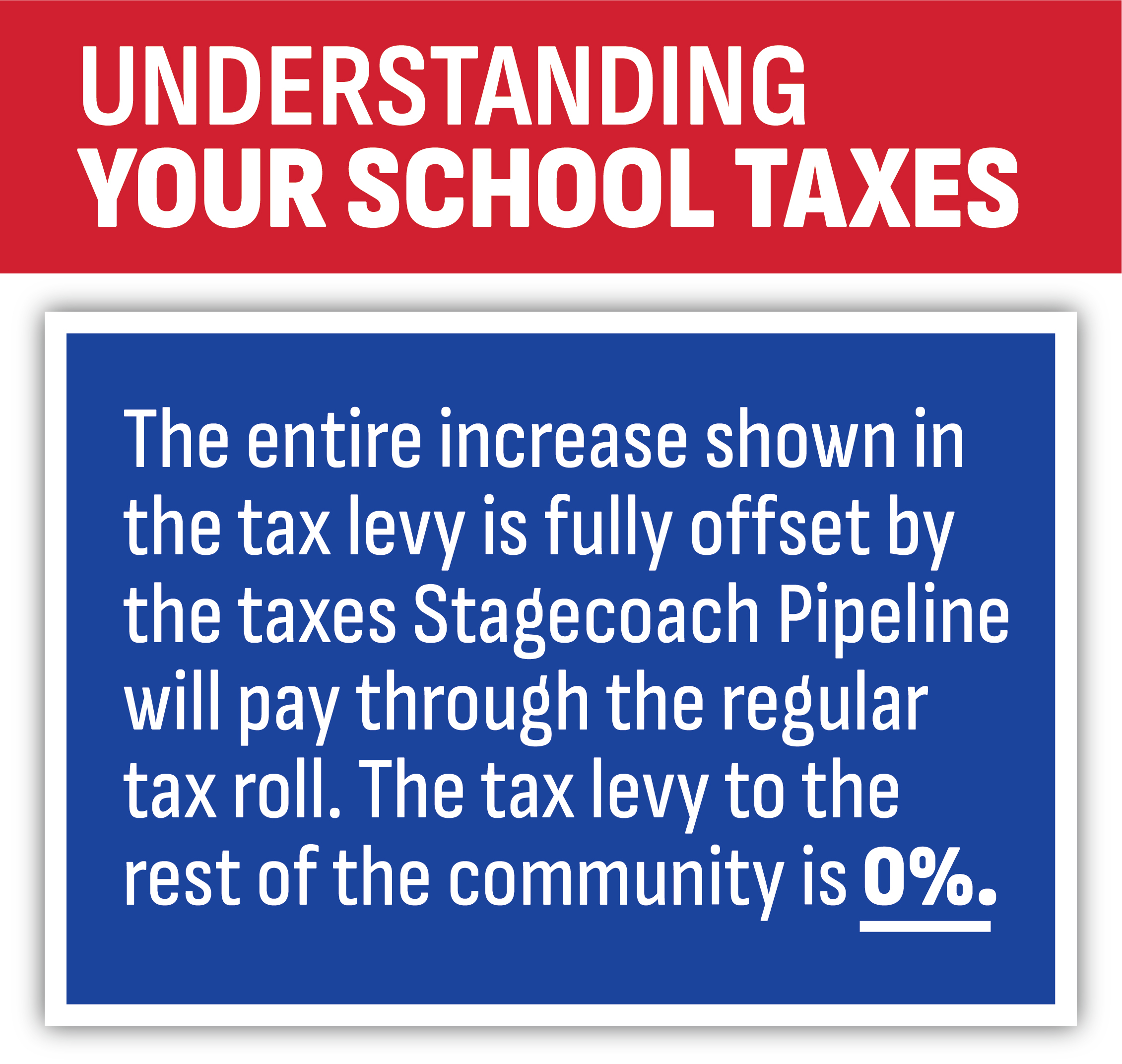
Understanding Your School Taxes & The Budget
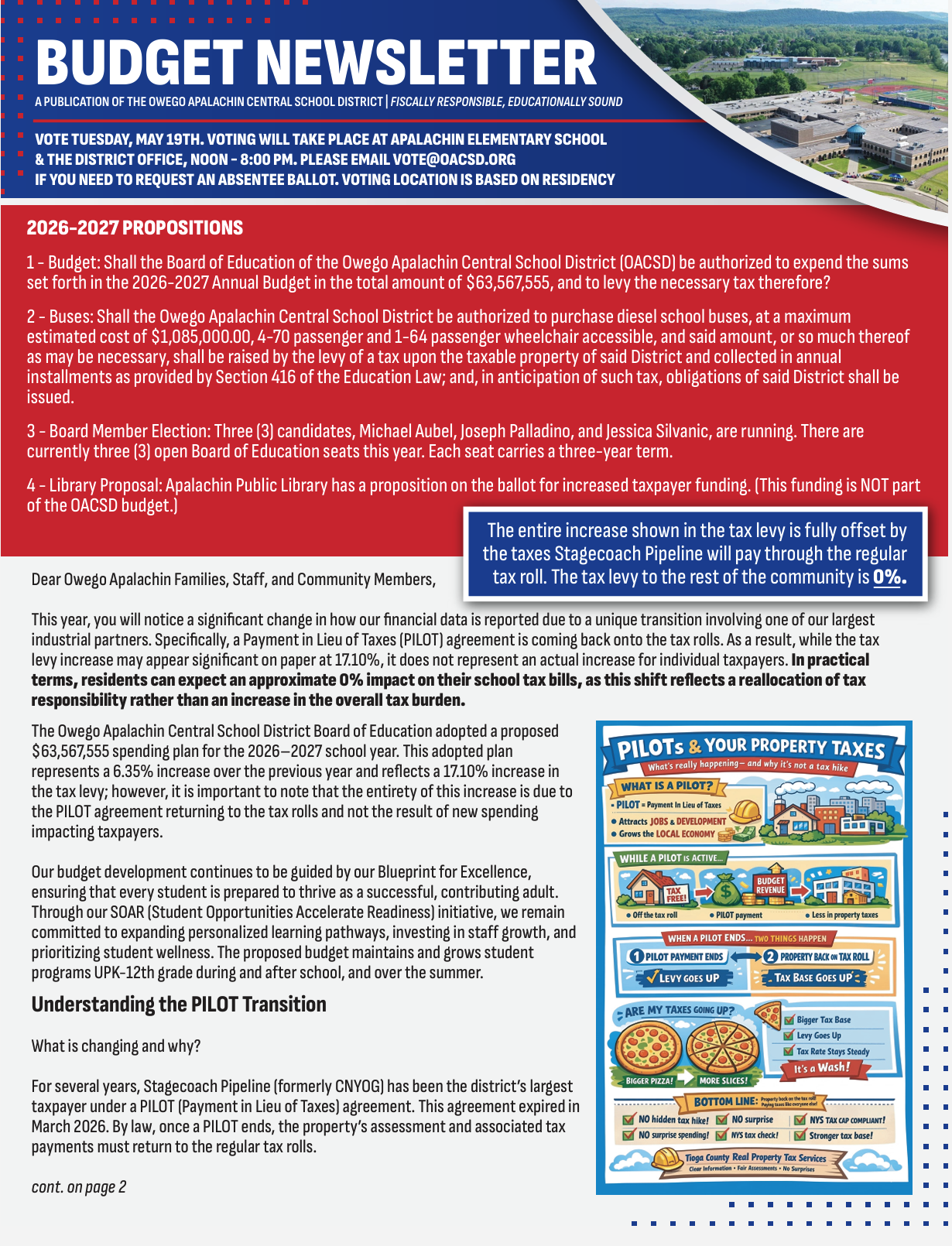
Click Image To Read The Budget Newsletter
Stagecoach Pipeline & Storage Company LLC (previously CNYOG) Pilot explained:
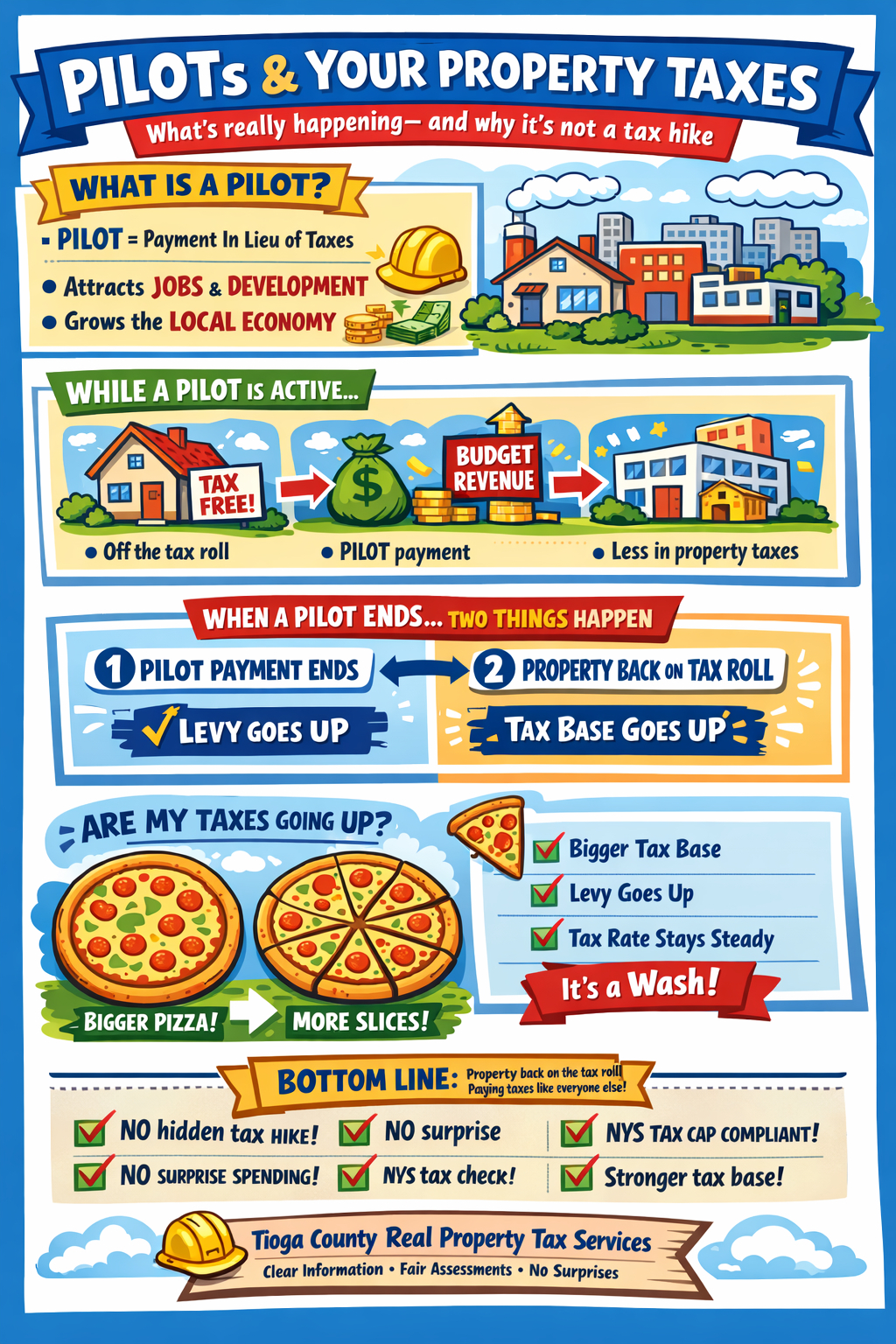
Understanding Property Taxes in Tioga County
Property taxes are one of the primary ways local governments and school districts fund essential services such as education, public safety, infrastructure, and community programs. While the system can appear complex, it follows a consistent and logical process each year.
Step 1: Assessing Property Value
Every property in a town is assigned an assessed value by the Town Assessor. This value represents the property’s worth in relation to other properties—not the taxes owed. Assessors do not set tax rates or determine tax bills. Their role is to ensure properties are assessed fairly and equitably based on market value and state standards.
Step 2: Creating Local Budgets
School districts, counties, towns, and villages each adopt their own budgets based on the cost of providing services for the coming year. Before determining how much must be raised through property taxes, other revenue sources—such as state aid, sales tax, and PILOT payments—are subtracted. The remaining amount is known as the tax levy.
Step 3: Apportioning the Levy Fairly
Because towns assess property at different percentages of market value, equalization rates are used to convert assessed values to full market value. This ensures that each municipality contributes its fair share of the tax levy based on true property value.
Step 4: Calculating the Tax Rate
The tax rate is calculated by dividing the tax levy by the total taxable assessed value. As a result, tax rates can change not only when budgets change, but also when the total taxable value changes.
Why Tax Bills Can Change Without New Spending
Tax bills may change due to shifts in assessed value, new construction, properties returning to the tax roll, expiring exemptions or PILOT agreements, or changes in equalization rates. An increase in the tax levy does not automatically mean higher taxes for individual property owners.
The Big Picture
Property taxes are the result of fair assessments, responsible budgeting, and equitable distribution across the tax base. Understanding how these components work together helps explain why changes on paper do not always translate into increased taxes for taxpayers.
Understanding PILOTs and School District Tax Levies
This overview is intended to help school boards, administrators, and community members understand how Payments in Lieu of Taxes (PILOTs) affect school district budgets, tax levies, and the tax cap.
What is a PILOT?
A Payment in Lieu of Taxes (PILOT) is an economic development agreement between a property owner and local taxing jurisdictions, including school districts. Instead of paying full property taxes immediately, the property owner makes scheduled PILOT payments that typically start lower and increase over time.
How PILOTs Are Reflected in School Budgets
For school districts, PILOT payments are treated as a separate revenue source and are deducted from the budget before calculating the tax levy. While a PILOT is active, the associated property is removed from the taxable portion of the assessment roll and classified as exempt.
What Happens When a PILOT Ends?
When a PILOT expires, two changes occur simultaneously:
1. The final PILOT payment is no longer available as budget revenue, which causes the tax levy to increase by that same amount.
2. The property returns to the taxable portion of the assessment roll, increasing the district’s total taxable assessed value.
Because these changes happen at the same time, the increase in levy is offset by an increase in taxable value.
Why the Tax Rate Changes Very Little
Although the levy may increase when a PILOT ends, the tax rate is calculated by dividing the levy by the total taxable assessed value. When both increase proportionally, the resulting tax rate typically changes very little.
Key Points for School Districts to Communicate
- The expiration of a PILOT does not represent a new spending decision by the school district.
- The apparent increase in the tax levy is an accounting shift, not a structural tax increase.
- The school district receives the same value in revenue, just through standard taxation instead of a PILOT.
- Returning properties strengthen the long-term tax base for the district.
Bottom Line
When a PILOT ends, the school district’s financial position remains stable. The transition reflects a shift from PILOT revenue to traditional property tax revenue, with minimal impact on individual taxpayers and full compliance with the New York State tax cap.
Steven Palinosky, CCD
Tioga County Director of Real Property Tax Services
2025-2026 BOE Election and Budget Vote Results
Owego Apalachin Central School District
2025-2026 School Budget Vote and Board of Education Election Results
Tuesday, May 20, 2025
Voters in the Owego Apalachin Central School District on Tuesday, May 20, 2025, voted to approve the district’s proposed 2025-2026 school budget of $59,769,964. The budget had a tax levy increase of 1.99 percent.
The final vote was:
Yes: 585
No: 297
In the second proposition, voters approved the purchase of 5 school buses by the following count:
Yes: 601
No: 278
The two Board of Education Candidates elected for the two seats were:
Linda Gretz and Theresa Heimbuecher
Votes Per Candidate
Linda Gretz: 569
Theresa Heimbuecher: 183
Ted McDonald: 128
(40 additional people received votes - contact the district clerk for additional information.)
Voters approved the additional taxpayer funding for the Apalachin Public Library.
Yes: 604
No: 277
Click here for the PDF version of the letter: https://5il.co/3gqbl.